
What is Clear Thinking?
How to Think Clearly and Logically in a Complex World
Clear thinking is the ability to assess situations logically, without being swayed by emotions or cognitive biases. It enables us to recognize obstacles, solve problems effectively, and make better decisions. This skill is increasingly important in today’s complex world, where we’re constantly bombarded with misinformation, but we are equipped with brains evolved during simpler times.


Why Clear Thinking Is Critical Today?
Navigating an Age of Information Overload
We live in a world of information overload, where false or misleading content is abundant. Whether it’s information coming through social media, advertisements, or political messaging, we must be armed with clear thinking skills to discern truth from fiction.
In addition to facing external threats offering flawed information, we must also protect ourselves from our own biases, ignorance, and incorrect assumptions. Developing clear thinking is essential not only for protecting ourselves but also for thriving in today’s fast-paced, information-driven world.
The Challenge of Thinking Clearly
Overcoming Overconfidence and Cognitive Biases
Thinking clearly isn’t always easy. Research shows that most people overestimate their abilities in many ways. For example, when asked if they are above-average drivers, most people say yes, even though this is statistically impossible. We do the same with our ability to think logically, most of us believe we think more clearly than the average person—but this, too, is often incorrect.
Being an effective thinker requires more than just self-confidence and having a lot of knowledge of expertise. It involves recognizing our cognitive biases and addressing them. We don’t always use logic, and emotions often override reason. This is not due to laziness or malice; it is because our brains are wired for certainty, simple narratives, and quick decisions, not for accuracy. While we can think logically, it requires practice and tools.
We Need a Network of Models and Tools
Subjective Experience, Objective Reality, and Epistemic Clarity
Many people consider reason, emotion, and intuition as simply different ” ways of knowing.” To some extent, this is true—we can learn much about the world from our emotions and intuition. However, the trouble arises when we assume all “ways of knowing” are equal and interchangeable, applying them to the wrong topics.
We feel when we should think (and sometimes vice versa), we confuse beliefs and opinions with facts, and we reject facts that make us feel uncomfortable.
This is where epistemology—the branch of philosophy devoted to understanding “ways of knowing”—becomes crucial. It teaches us how to distinguish between objective reality and subjective experience.
While “epistemology” sounds like a big and intimidating word, it is simply the set of tools we all use, consciously or not, to determine what is true and what is not. So, we are all epistemologists whether we realize it or not–the only
choice is to decide whether to become skillful epistemologists or not.
Developing epistemic clarity—the ability to tell the difference between subjective experience and objective reality—is at the heart of clear thinking of being a good epistemologist, which simply means being a clear thinker. You can’t be an effective leader without it.
It helps to remember:
Subjective Experience is our unique, non-rational, and feeling-based responses to the world (e.g., preferences in music, cuisine, or aesthetics).
Objective Reality is the facts that remain true regardless of how we feel about them (e.g., the laws of physics or mathematical truths).
Epistemic Clarity is the skill of distinguishing between subjective experience and objective reality.

How Skepticism, Probability, and Falsification Enhance Clear Thinking
Foundations of Clear Thinking
Skepticism, probability thinking, and skillfully developing hypotheses are essential for clear thinking. Skepticism helps us question assumptions and challenge information, preventing blind acceptance. Probability thinking allows us to make decisions based on uncertainty, considering the likelihood of various outcomes rather than striving for certainty.
The skillful developing of hypotheses involves three steps: Conjecture encourages curiosity and hypothesis formation when faced with incomplete information, leading to deeper exploration. Explanation forces us to clarify and organize our thoughts, ensuring better understanding. Falsification ensures our ideas are tested and refined, avoiding confirmation bias and strengthening our conclusions.
Together, these principles enable us to think critically and navigate complexity with clarity.
Skepticism is based on:
- Clarifying the claim
- Being open-minded but demanding evidence
- Ensuring the evidence fits the claim
- Keeping our confidence in proportion with the evidence
Probability Thinking involves:
- Accepting uncertainty instead of relying on certainties
- Assigning probabilities based on data and reasoning
- Updating your beliefs with new information
- Weighing risks based on expected value
- Considering ranges of possible outcomes
Conjecture, Explanation, and Falsification involves:
- Identifying a problem
- Proposing an explanation through conjecture
- Eliminating errors through argumentation
- Identifying the new problem and repeat
- Continually improving our ability to master clear thinking skills
Keep This in Mind: The Brain Loves Stories
When trying to understand the workings of the mind, always remember one fundamental fact: The brain loves to create stories.
Your brain constantly filters through data and turns it into a narrative. This process reduces stress and uncertainty by fitting information into an understandable context, even if that context is entirely fabricated.
This isn’t always a bad thing—it’s what allows us to recognize patterns and prepare for what the future could bring our way. But our brains often struggle to distinguish true stories from false ones. As a result, we may construct explanations for events that are simple and satisfying but often incorrect.

Gain Clarity, Confidence, and Intentionality
The ATA Clear-Thinking Framework
Incorporating the ATA Clear-Thinking Framework into your thinking process ensures that you not only recognize these obstacles but also have the tools to overcome them. Whether it’s identifying your cognitive biases, improving your decision-making, or acknowledging how your Enneagram personality type influences your perspective, the ATA Clear Thinking framework, part of the broader teaching on the Awareness to Action Enneagram, helps you navigate the complexities of modern life with clarity and confidence.
By applying the ATA Clear-Thinking Framework, you gain a deeper understanding of yourself and the world around you. This clarity empowers you to approach challenges with a balanced mindset, communicate more effectively, and make decisions that align with your values and goals. It’s not just about thinking more clearly—it’s about living more intentionally.
Five Obstacles to Clear Thinking
Many factors lead to our inability to see as clearly as we could. The ATA Clear-Thinking Framework identifies five obstacles to clear thinking: built-in cognitive biases, personality patterns, cultural influences, ignorance, and misinformation. It provides tools, concepts, and skills to reduce these obstacles and enhance your decision-making abilities.
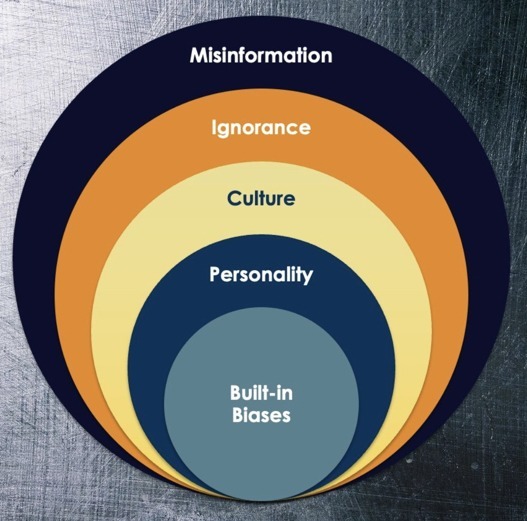
Built-in Biases: These are inherent in every human mind, distorting our perception of reality. The ATA Enneagram system helps you recognize these biases and avoid their influence on your thinking.
Personality: Your Enneagram personality type shapes how you filter and interpret experiences. The ATA Enneagram model framework offers tools to become aware of this filter and adjust your thinking accordingly, helping you see things more objectively.
Cultural Influences: The culture you live in can color your perspective (as can workplace culture), often limiting clear thought. By acknowledging and addressing these influences, the framework helps you expand your awareness.
Ignorance: Lack of knowledge can be a significant barrier to clear thinking. The framework emphasizes ongoing learning to combat this.
Misinformation: In a world rife with false information, the ATA Framework equips you with the skills to discern truth from fiction.
Five Aides to Clear Thinking
A structured approach to developing tools for clear thinking.
The solution to becoming a better thinker lies in structured training. The ATA Clear-Thinking Framework provides tools to help leaders and individuals develop the skills needed for clear thinking. These five abilities are:
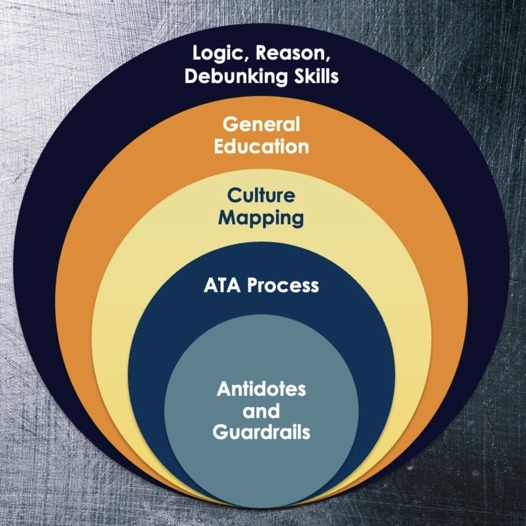

Protecting Ourselves Against Our Built-In Biases: The ability to establish antidotes and guardrails to help protect us from our non-conscious biases.
Identifying Cultural Bias: The ability to recognize and address cultural factors that can limit our perspective.
Creating Change with the ATA Process: The ability to rewrite our internal narratives in a way that both uses and helps overcome our habitual personality patterns.
Overcoming Ignorance: The ability to create a plan for broad learning that reduces our ignorance.
Guarding against misinformation: The ability to intellectually cut through the sea of misinformation we encounter each day.
Clear Thinking for Leaders
A structured approach to developing tools for clear thinking.
How to think clearly and logically is not just a personal pursuit—it’s vital for effective leadership. The most successful leaders understand the value of clear thinking.
Leaders must be able to see the world as it is, not as they want it to be. Every decision a leader makes, every judgment, is influenced by their ability to think well. They must separate fact from fiction and act in the best interests of their teams and organizations. Failing to do so is an abdication of leadership responsibility.
Testimonials
Start Your Journey Today
Executive Coaching
Preparing high-performing
leaders to scale effectively.
Group programs
Creating understanding around group
behavior through the Enneagram.
Enneagram OnDemand
Our asynchronous, self-directed introduction to personalities at work.
Why Clear Thinking Matters
Learning how to think more clearly is essential because ideas have consequences. The way we think shapes our decisions, actions, and the world around us. When we think clearly, we make better choices and avoid harmful mistakes. On the other hand, unclear thinking, clouded by bias or misinformation, can lead to disastrous outcomes.
In collaborative settings, clear thinking is vital for effective communication and mutual understanding. It fosters productive relationships and helps avoid misunderstandings. Additionally, assessing the credibility of information is crucial today. Clear thinking allows us to evaluate sources and make informed decisions, protecting us from misinformation.
Clear thinking empowers us to make sound judgments, communicate effectively, and navigate life’s complexities with confidence and integrity.
How to think more clearly, make better decisions, and navigate challenges with confidence