
What is the Enneagram?
The ATA Enneagram of Personality Explained
Are you ready to gain a deeper understanding of yourself? The Enneagram is a powerful tool for understanding personality. It describes nine distinct personality types, each represented by a point on a nine-pointed diagram. The Enneagram provides insights into our core motivations, values, and behaviors, helping us recognize our strengths, blind spots, and areas for growth. It helps people better understand themselves and their relationships, both personally and professionally.
The Awareness to Action Approach to the Enneagram (the “ATA Enneagram”) is an advanced version of the Enneagram, an evolution of the system refined over nearly 30 years of use to create transformation in individuals and teams in organizations across the globe. It is a model of personality that is simple, direct, accurate, and profound.


Enneagram Definition:
A Map of Personality and Behavior
The term “Enneagram” comes from the Greek words “ennea,” meaning “nine,” and “gram,” meaning “drawing.” The “Enneagram” literally refers to a diagram with nine intersecting lines creating nine points enclosed in a circle, each representing a distinct personality type.
The lines in the diagram also reflect the complexity of human behavior, illustrating how individuals psychologically “move” between different tendencies at various times, while still displaying consistent patterns. The Enneagram of Personality describes nine adaptive strategies–habitual patterns of thought, feelings, and behaviors–we use to solve the problems life brings our way. The ATA Enneagram shows how each of us tends to express one of these strategies more consistently than the others.
The Lines in the Enneagram Diagram
The Dynamics of the Connecting Points
On the Enneagram diagram, each strategy is connected by lines to two other strategies on the diagram, forming a unique inner structure for each Enneagram type. These connections are often referred to as ‘connecting points,’ revealing how individuals may express traits of other types under certain conditions. Here’s an overview:
Preferred Strategy: The strategy we rely on most naturally to interact with the world and that we often refer to as type.
Neglected Strategy: The strategy we sometimes wrongly believe will undermine our ability to feel the preferred strategy.
Support Strategy: The strategy we frequently rely on to reinforce our ability to feel our preferred strategy.

The History of the Enneagram
The Enneagram of personality, as we know it today, began in the 1960s with Oscar Ichazo, a Bolivian philosopher and mystic. Ichazo introduced the concept of mapping nine distinct personality types to the Enneagram diagram, linking these types to motivations, fears, and behavioral patterns to create a system for self-awareness and growth.
Chilean psychiatrist Claudio Naranjo, one of Ichazo’s students, further developed the system by incorporating psychological principles from the Diagnostic and Statistical Manual (DSM) and Gestalt therapy. Naranjo’s contributions expanded the Enneagram’s application to modern psychology and helped popularize it for broader audiences.
While inspired by older philosophical and spiritual ideas, the Enneagram as we know it is a modern construct shaped through synthesis, adaptation, and contributions from various teachers since the 1970s.
The Two Dimensions of Personality in the Enneagram
- Instinctual Biases: The first dimension of the ATA Enneagram is our inherent system of instinctual values—what we habitually focus our attention on and what is important to us. These are the core values that drive our priorities and behavior.
- The Nine Strategies that form the Enneagram Types: The second dimension is the nine strategies we use to satisfy those values. Rooted in habitual patterns of feeling, thought, and behavior, we use these strategies to adapt to our world and satisfy the prioritized by the instinctual biases.
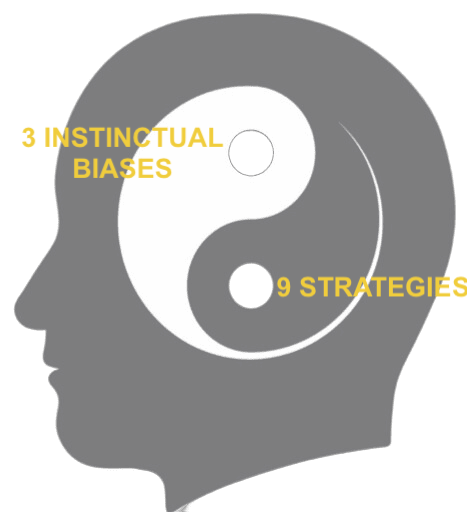
Dimension 1: The Three Instinctual Biases
The first dimension of the Enneagram relates to our Instinctual Biases—the deeply ingrained tendencies that dictate what aspects of life we prioritize and focus on. These biases fall into three categories, each influencing how we approach work, relationships, and decision-making.

Preserving Instinctual Bias:
People with a preserving Instinctual Bias are focused on security and survival. Their primary concerns include health, safety, and stability.
Preserving Leaders: They excel at creating secure environments and maintaining stability. They tend to be risk-averse and often focus on procedures, administrative tasks, and execution to ensure things run smoothly.

Navigating Instinctual Bias:
Individuals with a navigating Instinctual Bias are oriented toward group dynamics and social connections. They are concerned with trust, reciprocity, and understanding social hierarchies.
Navigating Leaders: These leaders have a natural ability to read the pulse of a group and understand organizational politics. They excel at building alliances and creating cohesion within teams.

Transmitting Instinctual Bias:
Those with a transmitting Instinctual Bias focus on influence and spreading ideas. They are concerned with leaving a lasting impact by passing on their values, beliefs, or knowledge.
Transmitting Leaders: They are often charismatic and bold, inspiring others with their vision. These leaders excel at building relationships with clients, partners, and allies, helping to drive business forward.
Dimension 2: The Nine Enneagram Types
The second dimension of the Enneagram describes nine adaptive strategies, which are referred to as Enneagram types, that individuals use to navigate life. Each type has a specific approach to fulfilling Instinctual Biases.
Type One
Striving to Feel Perfect
Enneagram Type Ones are principled, orderly, and committed to doing things the “right” way. They focus on rules, procedures, and high standards. However, they can become overly critical and rigid when their desire for perfection is overdone.
Type Two
Striving to Feel Connected
Enneagram Type Twos are empathetic and nurturing, driven by a need to form strong relationships. They often focus on helping others but may neglect their own needs in the process, becoming dependent on others for emotional support.
Type Three
Striving to Feel Outstanding
Enneagram Type Threes are ambitious and success-oriented. They work hard to excel and often project an image of confidence and achievement. However, they may become too focused on appearances, valuing image over substance.
Type Four
Striving to Feel Unique
Enneagram Type Fours are creative and expressive, often seeking to differentiate themselves from others. They value uniqueness and often gravitate toward artistic or unconventional experiences. In stress, they may feel misunderstood or isolated.
Type Five
Striving to Feel Detached
Enneagram Type Fives are thoughtful and private, preferring to observe the world from a distance. They focus on knowledge and problem-solving but may struggle with emotional expression and connection with others.
Type Six
Striving to Feel Secure
Enneagram Type Sixes are loyal and community-oriented, seeking safety in numbers and traditions. They are vigilant and responsible but may become anxious or overly cautious in uncertain situations.
Type Seven
Striving to Feel Excited
Enneagram Type Sevens are curious, optimistic, and always looking for the next exciting opportunity. They focus on possibilities but may become scattered or impulsive when overwhelmed by too many options.
Type Eight
Striving to Feel Powerful
Enneagram Type Eights are confident, assertive, and driven by a need to control their environment. They focus on action and overcoming obstacles but may come across as domineering or aggressive if they feel threatened.
Type Nine
Striving to Feel Peaceful
Enneagram Type Nines are calm, easygoing, and seek inner harmony. They prioritize maintaining peace in their environment, sometimes at the expense of addressing their own needs.
Combining the Two Dimensions:
A Deeper Understanding of the Enneagram of Personality
When the instinctual biases (what we prioritize) and the strategies (how we get what we prioritize) are combined, we end up with 27 variations or “subtypes.” It is here that we really get to understand the depth and subtlety of the ATA Enneagram. We start to understand the real reason why there is such variation among people of the same Ennea-type, why this Seven doesn’t quite look like that Seven.
These subtypes offer a rich and nuanced perspective on human behavior, providing personalized insights into how individuals navigate personal growth and workplace challenges.

The ATA Enneagram Approach
What is the Enneagram for Awareness to Action?
The Enneagram is a model of personality styles, and the ATA Enneagram is a specific approach to this model based on nearly 25 years of applying the Enneagram in real-world settings. Our unique approach—the ATA Enneagram—combines the depth of the traditional Enneagram with practical strategies for success in both the workplace and personal life.
Whether you’re looking to improve team dynamics, enhance leadership skills, or deepen your understanding of personal motivations, the ATA Enneagram offers a roadmap for growth and success.
At Awareness to Action International, we understand that personality types do not determine success but provide a framework for leveraging strengths and addressing obstacles. Our ATA Enneagram model is trusted by organizations worldwide to help employees and teams maximize their potential.
Advancing the Enneagram: The
Awareness to Action Enneagram Explained
A Practical Approach to the Enneagram of Personality
The Awareness to Action Enneagram is tailored for those who value pragmatic tools for improving decision-making, enhancing leadership skills, and driving meaningful change. Unlike traditional approaches, this model focuses on clarity, practicality, and evidence-based insights, making it highly effective in modern environments.
The ATA Enneagram is:
- Purpose-driven: Built for people who prioritize practical applications over theory.
- Scientifically-informed: Grounded in logic, reason, and real-world evidence.
- Global applicability: Proven effective in diverse industries and cultures worldwide.
What is the Enneagram Growth Path for the ATA Model?
Your ability to be successful—as an individual or as part of a team—is limited by your understanding of human nature.
Self-awareness is essential, but it holds limited value if it doesn’t lead to meaningful action. The Awareness to Action Enneagram goes beyond self-awareness by providing practical tools to help individuals see the world more clearly and act with wisdom and compassion. Its ultimate goal is to empower people to improve their lives, relationships, and professional environments.
We don’t try to change people; we work with who they are, and we work with them in a way that respects their values. We help you elevate your capacity to get results. We do this by identifying ineffective narratives and helping you unleash your power to lead at a higher level.
Here’s how:
Step 1: Awareness
We help you see the habitual patterns that might be holding you back and limit your ability to grow.
Step 2: Authenticity
We help you resolve the inner conflicts that you may not even be aware of so you can overcome those obstacles and create lasting growth.
Step 3: Action
We help you create clear and precise action plans that move you toward your goals and establish new ways of thinking and responding adaptively to changing circumstances.
Unlocking Success Through the ATA Enneagram of Personality
Leverage Your Enneagram Personality Style Profile to Overcome Blind Spots and Maximize Strengths
People with all sorts of personalities can be successful at work. There are successful introverts and extroverts, optimists and pessimists. Our personality style doesn’t determine our success, but while it is often the source of many strengths, it can also create blind spots and obstacles that hold us back. The value of personality models like the Enneagram lies in their ability to provide a framework for leveraging strengths and more quickly recognizing blind spots. A good model can also offer roadmaps for overcoming obstacles and fostering personal and professional growth. No model of personality styles does this better than the Awareness to Action (ATA) Enneagram, which is uniquely designed to help individuals navigate these challenges with clarity and purpose.

Testimonials
Start Your Journey Today
Executive Coaching
Preparing high-performing
leaders to scale effectively.
Group programs
Creating understanding around group
behavior through the Enneagram.
Enneagram OnDemand
Our asynchronous, self-directed introduction to personalities at work.
The Benefits and Flaws of Enneagram-Type Assessments
What is the Enneagram Test and the ATA’s approach?
In theory, an Enneagram test helps individuals identify their type, offering insights into their personality and how they engage with the world. In reality, the use of online Enneagram-type assessments offers a mix of benefits and flaws. On the positive side, these assessments are easy to use, visually appealing, and can provide individuals with a starting point for self-discovery.
However, these assessments often have significant limitations. They can be inaccurate due to the complexity of the Enneagram, cultural factors, and biases such as confirmation or automation bias that can lead individuals to misidentify their type. Furthermore, they often rely on generalized questions that may reflect stereotypes rather than capture the nuanced expression of personality types.
Critical thinking is crucial when using Enneagram assessments. To mitigate the issues, it’s recommended that assessments be used as provisional tools, accompanied by deeper, more personalized exploration of type through conversation and reflection.
You can take the ATA Enneagram test and our Instinctual Bias assessment here:
Summary
Out of all the personality models, the ATA Enneagram stands out for it’s practicality and effectiveness. It provides a clear framework for understanding one’s instinctual values and the strategies used to fulfill them, making it a valuable tool for personal growth and transformation. The ATA model can be applied in diverse settings, including coaching, leadership development, team building, and self-awareness. It helps individuals uncover their key challenges, recognize blind spots, and develop actionable strategies to overcome them, fostering authentic growth and more effective leadership.
Whether you’re striving to improve your leadership skills, enhance team collaboration, or better understand your own motivations, the Awareness to Action Enneagram offers the insights and resources you need to succeed.