
ATA Enneagram Type 3 Personality Style
ATA Enneagram 3 – Striving to Feel Outstanding
ATA Enneagram Threes interact with the world by Striving to feel Outstanding.
They work hard to exceed standards and to be successful in whatever they undertake. They place high value on productivity and presenting an image of being a winner in whatever environment they are in. When they overdo their Striving to Feel Outstanding they may become attention-seeking and may value image over substance. When stressed, Threes may fear that if they are not making great efforts to be excellent they will become mediocre.

Chief Asset: Achievement. Threes have a unique capacity for self-actualization and success in whatever endeavors they pursue.
What They Like in Others: Prestige, success, efficiency.
What They Dislike in Others: Failure, emotions, indifference to their achievements.
How They Frustrate Others: Self-centeredness, overselling themselves, cutting corners.
Approach to Problem Solving: “Let’s just concentrate on getting this done.”
Belief About Work: “Things work best when I’m given a chance to shine.”
How Others See Threes: Ambitious, successful, goal-oriented, focused, competitive, but sometimes egotistical, political, shallow, deceptive, and attention-seeking.
Threes Get Into Trouble When They Tell Themselves: “My value is based on my actions and accomplishments and the way I am perceived by others.”
Enneagram Three Leadership & Communication Style
The Type One Leader: The Pacesetter
The High Side of the Pacesetter: Threes inspire others by setting an example of high performance and excellence.
The Low Side of the Pacesetter: Threes can place unrealistically high expectations on people and may not consider the needs and values of others.
Where They Shine: When pursuing a goal. Threes love to have an opportunity to demonstrate their abilities, make a contribution, and challenge themselves.

Type Three Enneagram Communication Style:
• A Three’s communication tends to mix goal and task focus with personability.
• They like conversation to focus on the positive and generally avoid focusing on roadblocks.
• They avoid conflict when possible and feel that conversation (especially at work) should be casually formal.

Derailers for Type Threes
- Spin and wanting to look good: The tendency to put the best possible face on things or events, which at times involves leaving out of less attractive facts; can cause lack of trust from others.
- Taking on too much (“I’ll do it” syndrome): Desire to be highly accomplished and seen as adding value leads to taking on too many projects.
- Not seeming “knowable”: Trying to be all things to all people leads to being unknown to all; having no “nooks and crannies”; others sometimes perceive you as being superficial.
- Seeking recognition: Bringing attention to your accomplishments and importance.
- The Individual Contributor syndrome: Seeing other people as impediments who often slow down your progress and ability to accomplish your goals; failure to nurture subordinates because you prefer to “lead by example.”
Blind Spot for the ATA Enneagram 3: Inauthenticity
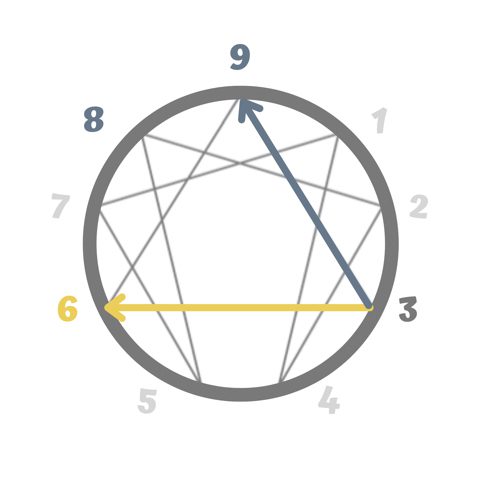
Connecting Points for ATA Enneagram Type 3
Support Strategy at Point 9: Striving to Feel Peaceful
Enneagram Threes often have a demeanor of calm competence, always seeming to have their lives under control. Sometimes, however, the outer calm is a façade that masks anxiety caused by the pressure they put on themselves to achieve.
Neglected Strategy at Point 6 – Striving to Feel Secure
While Threes often have a good strategic sense that allows them to avoid unnecessary risk to their reputation, there are critical times when they neglect caution and
stretch themselves beyond their capacity to accomplish what they commit to.
Listen to the Conversation about ATA Enneagram Type 3
The Awareness to Action Enneagram Podcast
In this episode of the “Awareness to Action Enneagram Podcast,” Mario Sikora, María José Munita, and Seth “Creek” Creekmore discuss Enneagram Type Three, “Striving to Feel Outstanding.” Drew Moser, co-host of Fathoms | An Enneagram Podcast, joins them to share how being a Type Three shows up in his life. The four talk about how Type Threes aim to feel like they’re standing out in some way, the blind spots that occur from this, and how there’s so much more going on under the surface. They discuss the misconception that while Type Threes can appear self-centered and selfish, they also want to make other people’s lives better as well.
“I think that’s at the core of the Type Three is that they’re always calibrating the proposition of their lives.” -Drew [09:07]
“So they have this reputation in the Enneagram world of being self-centered and selfish, but healthy Threes are really, really trying to make the world better for everybody.” -Mario [11:13]
“All I’m hearing is the pattern of expression is as sure as gravity, is what Mario is saying.” -Creek [23:22]
“I wanted to highlight how your description of Type Nine is nothing close to what a Nine would say about being a Nine, I think, because of how a Three embodies the Type Nine strategy of ‘Striving to Feel Peaceful,’ and that’s interesting.” -María José [34:57]
ATA Enneagram Type 3 Subtypes
The striving to feel outstanding in ATA Enneagram Type Three is uniquely expressed through the three Subtypes.
| OUTSTANDING PRESERVING | OUTSTANDING NAVIGATING | OUTSTANDING TRANSMITTING |
|
|
|
Explore the Other Types
Growth for ATA Enneagram Three: Purpose
Threes, who are striving to feel outstanding, are action and task-oriented “doers” who are often in constant motion as they seek achievement. Unfortunately, this need to achieve can be indiscriminate—they take on too much and there is no clear coherence to their activities. They take on tasks outside their area of responsibility, struggle to delegate, and, in general, spread themselves too thin. They end up feeling like a hamster spinning on a wheel— working hard to get nowhere.
Purpose is the guiding intention that ties together our activities. Writing a purpose statement gives the Three direction and allows them to prioritize their activities in a way that gives meaning to those activities. It makes clear what they should say “yes” to and, even more importantly, what they should say “no” to. Writing a purpose statement does not need to be a daunting task—it is not a lifetime commitment to a particular cause; it is a statement that focuses one’s attention for the next, say, six months, year, or more. It should be flexible (but not too flexible) and reviewed and updated periodically.
Start Your Journey Today
Executive Coaching
Preparing high-performing
leaders to scale effectively.
Group programs
Creating understanding around group
behavior through the Enneagram.
Enneagram OnDemand
Our asynchronous, self-directed introduction to personalities at work.
A Fun and Informative Deep Dive into Understanding the Enneagram 3
Mario and TJ are joined by podcast co-founder and Season 1 co-host María José Munita to discuss the Enneagram Type 3, “Striving to Feel Outstanding,” through the films of Reese Witherspoon on this episode of the “Enneagram in a Movie Podcast.” While Reese hasn’t directed a movie yet, the three hosts explore her films in her role as an actress and producer, starting with “Legally Blonde” and “Election.”