
ATA Enneagram 5 Personality Style
ATA Enneagram 5 – Striving to Feel Detached
Enneagram Fives interact with the world by Striving to feel Detached.
Type 5s are observant, logical, and generally reserved. They focus on problem-solving, innovative ideas, and data gathering. When they overdo their Striving to feel Detached they can end up being dull—out of touch with their experiences and emotions. When stressed, Fives may fear that if they do not remain detached and guarded they will become uncontrolled.

Chief Asset: Insight. Fives have the capacity to analyze their environment quickly and synthesize their observations into the big picture. They see things that others do not.
What They Like in Others: Intelligence, innovation, curiosity.
What They Dislike in Others: Emotional reactions, high-pressure, crowds.
How They Frustrate Others: Lack of action, intellectual arrogance, withholding of emotions.
Approach to Problem Solving: “Let’s make sure we have all of the facts.”
Belief About Work: “Things work best when I’m left to my own devices.”
How Others See Fives: Strategic, visionary, perceptive, analytical but sometimes withdrawn, unresponsive, distant, lacking emotions.
Fives Get Into Trouble When They Tell Themselves: “I’ll be safe if no one knows what I truly think or feel.”
Enneagram 5s Leadership & Communication Style
The Type Five Leader: The Strategist
The High Side of the Strategist: Fives are highly analytical and able to develop a plan for getting from current reality to identified vision.
The Low Side of the Strategist: Fives can be remote and detached and focus more on analysis than action.
Where They Shine: At figuring things out. Fives are great in an environment where they have the opportunity to analyze, research, innovate, and solve complex problems.

ATA Enneagram 5s Communication Style:
- Fives tend to be deliberate and thoughtful communicators.
- They are unwilling to be rushed, releasing information on their own time.
- They tend to avoid displays of emotion (other excitement over ideas), preferring to focus on data and ideas.

Derailers for Type Five
- Thinking too much, doing too little: Preferring analysis to action and allowing that preference to affect performance.
- Not nurturing relationships: Neglecting to make contact with others and identify needs; avoidance of networking and social connection.
- Unaware of their surroundings and their own impact: Constant inward focus leads to not noticing the effects of your actions (or lack of action) on those around you.
- Needing to show off intellect: Showing off knowledge; too much attention to detail, hyper-verbosity in areas of expertise; “know-it-all-ism.”
- Not sharing information: Not communicating with others either through neglect or because you simply don’t want to share.
Blind Spot for ATA Enneagram 5: Intellectual arrogance
Fives are often unaware of their tendency to be intellectually arrogant and the effect it has on their relationships. They spend much of their time thinking about and analyzing life, while other people spend more time actually living life. Consequently, Fives may think that other people are less thoughtful and insightful and in the extreme, stupid and dull.
Connecting Points for ATA Enneagram Type 5 Personality Style
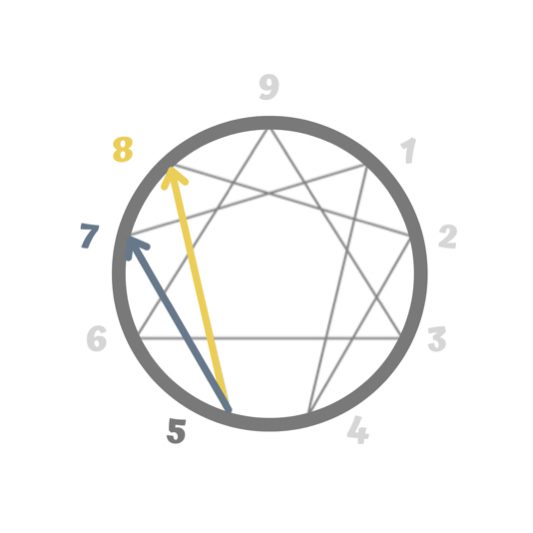
Support Strategy at Point 7: Striving to Feel Excited
Fives often have a child-like wonder, especially for the more abstract elements of life. Sometimes, however, this excitement for knowledge keeps them from interacting with the world.
Neglected Strategy at Point 8 – Striving to Feel Powerful
While Fives can be very influential, especially through thought leadership, there are critical times when they resist personal engagement with others, keeping their thoughts to themselves and thus missing an opportunity to shape their environment.
Listen to the Conversation about ATA Enneagram Type 5
The Awareness to Action Enneagram Podcast
In this episode of the Awareness to Action Enneagram podcast, Mario Sikora, María José Munita and Seth “Creek” Creekmore speak with Sali Honess-Ondrey, a clinical social worker and enneagram trainer, to discuss Enneagram Type 5 Personality Style. The name of this strategy, “Striving to Feel Detached,” typically gets pushback for its perceived negative connotation, but detachment is a required element of existence. Sali explains the role being a Type Five plays into her life and shares why a yucky truth is better than a sweet lie.
“It’s only negative when it’s being done in a maladaptive way, but the reality is that life requires emotional detachment for all of us.” -Mario [09:28]
“It’s not like I’m indifferent, but it’s that I’m just approaching it as this is the situation and we’re going to figure this out.” -Sali [15:05]
“I’ve seen Enneagram 5s use that ‘Striving to Feel Powerful’ by using their knowledge to eviscerate people.” -Creek [28:01]
“I couldn’t help thinking about this information and how it may look different for different subtypes of the Five. Like a different tone, but also a different topic.” -María José [37:54]
ATA Enneagram Type 5 Subtypes
The striving for detachment in Enneagram Type Five is distinctly expressed through the three Subtypes.
| DETACHED PRESERVING | DETACHED NAVIGATING | DETACHED TRANSMITTING |
|
|
|
Explore the Other Types
Growth for Enneagram Five: Conscious Practice
Fives, who are striving to feel detached, struggle to trust their intuitions and take action. Their impulse is to step back and disengage; to analyze, assess, and strategize. They often have an impact on their environment, but it is through influence and “thought-leadership” more so than through direct action. They often know a lot about an activity but may not have incorporated that knowledge into actual skill and capability. This gulf between knowledge and capability can make them even more reluctant to engage directly with others.
Conscious practice refers to the methodical development of and practicing a skill from the basics to the advanced stages. It refers to doing in a structured and intentional way—typically by taking methodical and incremental steps. It is not the amount of time devoted to the practice of an activity that matters, but the amount of attention we pay during that practice. In the same way that an athlete begins with the repetitive, focused practice of the fundamentals, Fives grow when they take their insights and put them to work in a deliberate, step-by-step action plan.
Start Your Journey Today
Executive Coaching
Preparing high-performing
leaders to scale effectively.
Group programs
Creating understanding around group
behavior through the Enneagram.
Enneagram OnDemand
Our asynchronous, self-directed introduction to personalities at work.
A Fun and Informative Deep Dive into Understanding the Enneagram 5 Personality
In this episode of “The Enneagram in a Movie Podcast,” Mario and TJ discuss the films of David Fincher to explore Enneagram Type Five, “Striving to Feel Detached.” They discuss the darker side of Fives that are evident in the films, “Seven” and “The Fight Club.” However, it should be noted that not all Fives are as dark and disturbed. They also discuss what makes Fincher a Five himself with the interesting dichotomy in his approach.